It is not uncommon to assume that you’ll have to prove negligence in your workers’ compensation claim, but these are actually two different kinds of cases. You do not need to prove that your employer was negligent in order to receive benefits, just focus on your recovery and healing. If you want to pursue a negligence case instead of a workers’ compensation case, you can, but it might take longer to receive benefits and medical care.
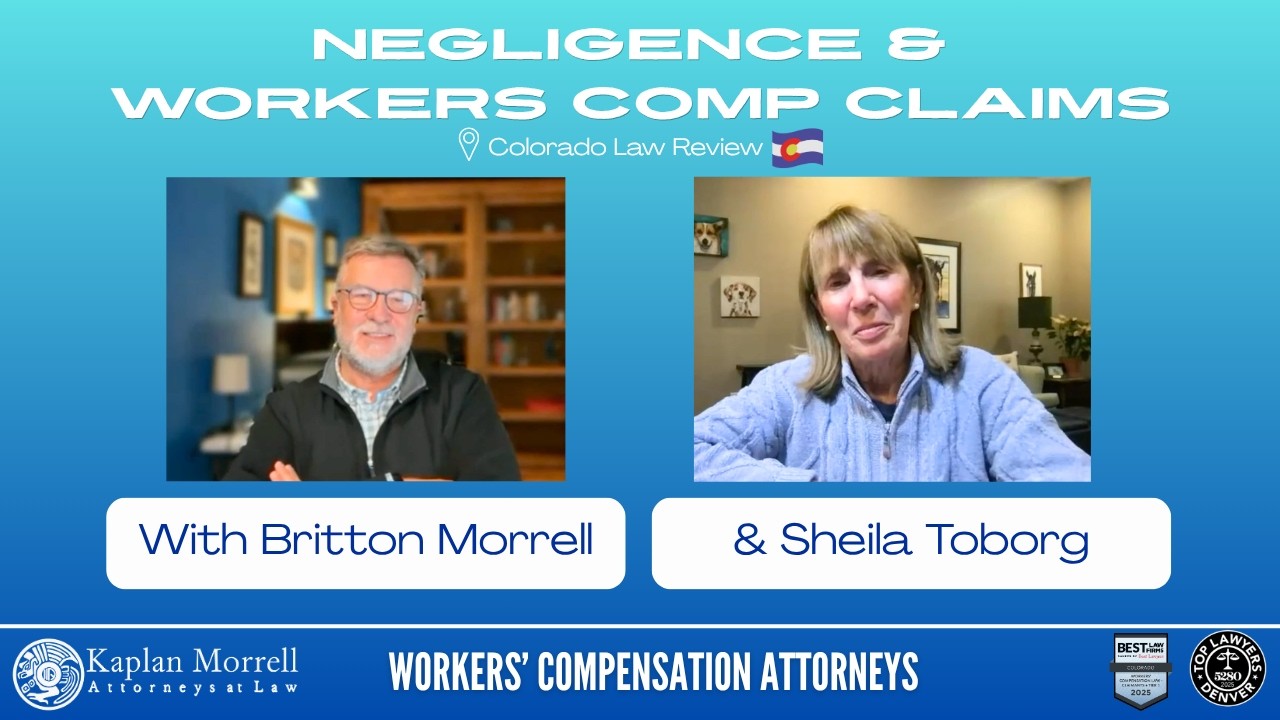
What is the difference between a negligence claim and a workers’ compensation claim? Attorneys Britton Morrell and Sheila Toborg explain.
You DO NOT need to prove negligence in your workers’ compensation claim. Focus on getting better.
Whether negligence had a role in your case or not, you do not need to spend your time and energy trying to prove that your employer was negligent. When an injury occurs on the clock, Colorado workers’ compensation insurance steps in to cover you, providing both medical coverage and lost wage benefits. And, the unfortunate truth is, even if the cause of your injury was due to negligence by your employer, you will not necessarily receive more in compensation.

Negligence falls under Personal Injury, and is an option, but can take time to resolve.
The advantage of pursuing a workers’ compensation claim over a negligence claim is the difference in time it takes for you to start receiving care and lost wages. With a workers’ compensation claim, you can start receiving treatment almost immediately, while a personal injury and negligence case can take more time as you gather evidence and build your case.
Kaplan Morrell can help with Personal Injury Claims
If you decide to pursue a personal injury and negligence claim, we can help. Fill out our intake form so we know the specifics of your case and can set up a free consultation.
What if your injury was due to your negligence?
Let’s say you are a construction worker working on a job site where hard-hats are required. In this one instance, you forget to put your hard-hat on and you’re struck by a beam that is being moved. What happens when your injury is due to your negligence? In this specific example, we would call this standard negligence. You simply forgot to put the hard-hat on. You were still injured at work, and so can receive Colorado’s workers’ compensation benefits. What your employer may try to prove is “willful” negligence, where in you willfully ignored the safety regulations, and so were injured on the job. In this case, your medical benefits will still be completely covered, but your monetary benefits will be reduced by up to 50%. This is why it is so important to get a lawyer to help guide you through your workers’ compensation claim and ensure that you receive the maximum amount of benefits and compensation.
Need Help Navigating Your claim?
The workers’ compensation process can be complex, strict with deadlines, and intimidating to navigate on your own. Since 1997, Kaplan Morrell has helped thousands of injured Colorado workers secure the full medical and financial benefits they deserve.
If you have questions about filing a claim or face friction from an insurance adjuster, we’re here to help. We represent injured workers throughout Colorado from our offices in Denver, Greeley, and Loveland, and also offer convenient virtual consultations for clients across the state. To learn more about our offices and the communities we serve, visit our Colorado law office locations page.
Call Us: 970-356-9898
Connect with us on 📸 Instagram – @KaplanMorrellLaw
Connect with us on 📘 Facebook – KaplanMorrell
Read the transcript from the video above.
We are going to absolutely try this out and see what we can do on this. And our topic right now is going to be negligence and workers’ compensation claims. And I am going to bring on Sheila Toberg.
Our topic is negligence and workers’ compensation claims. And you know, we talk about this because oftentimes we run into really interesting issues every week or so. And you and I were talking, and this was something where, you know, clients were asking, “Does negligence matter in a worker’s compensation claim?” What do you think?
You and I were talking earlier today whenever we have an injured worker. I have a client. I look at injury three ways, Britton. One, if somebody’s just injured, nothing to do with work—they’re out on their skateboard, they fall off—that’s horrible. Somebody gets injured at work, the same injury, it just amplifies things, you know, for our clients. But what I really find frustrating is when I have to explain to a client who has told me, “I have been injured because of my employer’s negligence,” and they think that because of that, they’re going to get more.
So, let’s just use—you know, we have the cold weather right now. I have a new client who slipped and fell going from the parking lot into the employer’s building. And as you had alluded to, we’re not talking about a situation where they have a third party that came in to clear the snow or where the parking lot is owned by somebody else. It’s the employer’s parking lot. And my client is there, broke his leg, and he says, “They were negligent. They did not get out there and put the stuff out there. They didn’t clear it right. And I should be getting so much more.”
And I had explained to my client, I said, “You know what? There’s still the three main categories of benefits. They don’t pay for pain and suffering. Life is crap because your employer was negligent.” It is really frustrating. I’m sure you’ve encountered the same thing.
Yeah, absolutely. They want to—they’re surprised. You know what I get is where they think they have to prove, the injured workers, have to prove that the employer was negligent in some way and they’re really fixated on it. “Oh, you know, it was this piece of machinery and we had complained about it, and there were complaints on it that the employer was not properly doing the maintenance or something, or it was a really dangerous environment and the employer knew about it, etc.”
And so I first kind of have to say to them, “Hold on. We’re not having to prove negligence in order for you to get covered. All that matters is: were you doing your job and you got injured?” And then they’re relieved on that, but then they’re surprised when they’re like, “But I don’t get more? I get the same?”
Exactly. And then they say, “Well, I had like two other co-workers. I mean, OSHA came in. All of these things are happening.” I have a client—I mean, they’re so angry in a situation like this. And then I have to still understand and empathize with what’s going on, but I’m going to say, “You know, the bad news is you’re not going to get more. The good news is if you had been negligent yourself, that wouldn’t keep you from having a claim.”
And it’s just, I think, the emotion that comes on as opposed to if somebody was injured and they did not believe it was because of their employer’s negligence. I think someone like that just needs to have much more empathy. You need to allow this person to vent about things, and it isn’t going to just be one time. I mean, I have clients that have been in situations like this and every time we talk it’s brought up again. And we just need to, again, listen, empathize, but then bring it back and say it isn’t going to make a difference. I mean, it’s horrible what happened to you, but it isn’t going to make a difference. They’re not going to pay you more money because of this.
I wish it were a two-way street. In other words, I wish that it was the same both ways. And in some ways, it is. I mean, the employer doesn’t get to escape responsibility for workers’ compensation claims if they can show that the injured worker has been at fault. And I know that you used to represent, for a while, employers and insurance companies in workers’ compensation. When you were dealing with employers, were you dealing with the reverse situation where they were like pissed off because, “Why do we have to pay for this injury? He should have known better. She should have known better.”
Exactly. And of course, when I was on the other side, it’s like a heightened standard. You’d have to actually prove that the injured worker willfully violated something or that there was intent. Intent really matters. It isn’t just your usual negligence. You have to take it a step further in order to be able to prove it.
Again, it doesn’t keep the injured worker from having a worker’s compensation claim. Even if they can prove the willful intent, they’re still going to get 100% medical. But where it can become a real issue then, if they actually are able to prove all of this, is it reduces monetary benefits, lost wages, and permanency benefits by 50%. On that, fortunately, this time around, I haven’t had to deal with it being on representing the injured worker’s side. And you’re right; employers are really upset. They can become really emotional too about things.
So we were talking a little bit—there is one part where it feels akin, where negligence plays a part, and that’s where an employer and an insurance company try to say, “Hey, the employee willfully violated a safety rule,” with that kind of intent, and because of that, they got injured. A classic example would be a construction worker who goes onto a construction site without a hard hat, and something falls and hits his head, and because he wasn’t wearing a hard hat, he’s injured. I’m not going to go into everything that’s needed to prove a safety rule violation—that’s a different conversation altogether.
So sometimes we’re left with saying, “Hey, it wasn’t willful. It was negligent. Our client was negligent, but he wasn’t willful.” And if they do succeed in showing it’s a willful safety rule violation, you’re still covered under comp—100% of your medicals are covered—but your monetary benefits are reduced by 50%, which is a hard penalty.
But again, sometimes negligence plays a part in workers’ compensation because we’re trying to prove, “Hey, it wasn’t willful. Our client was just being careless. He was rushing through things, he was distracted, etc.” And that’s why he or she didn’t wear the hard hat, didn’t buckle their seat belt, didn’t put on the safety things, etc. You know, in some cases, we do bring up negligence, but it’s just to save our client from getting a willful penalty against them.
Exactly. Colorado used to have no-fault auto insurance in terms of medical pay, and we don’t anymore, so this kind of phrase has dropped from a lot of people’s vocabulary. But work comp is a no-fault system, which means we don’t have to show negligence in order to get you covered. You get the same amount of benefits that you would get if they were negligent, if you were negligent, if no one was negligent, or if it was an act of God. You still get the benefits, so you don’t have to prove negligence to receive workers’ compensation.
If your injury comes across as somebody else’s negligence, it’s called a third-party claim, and there are a lot of rules on who that someone else has to be.
But if I could just interject here just so it’s clear: on this someone else’s negligence, that’s someone who’s not a co-worker.
That’s right. So that’s what I wanted you to do is give the examples of who really is a third party, Sheila.
Well, I always like to use the example that let’s say, Britton, you work for a pizza parlor and you are out delivering a pizza, and another driver hits you, is negligent, and they’re at fault. So they’re the true wrongdoer. At this point, you can’t bring a lawsuit against your employer, but you would have workers’ compensation, and that’s what they call subrogation: potential third-party liability.
But what happens then is—and probably you can explain even more eloquently than me—if there is that other wrongdoer, then the injured worker gets benefits under workers’ compensation, but the insurance company or self-insured employer can then go to recoup from the true wrongdoer, assuming that they have insurance.
Or one thing that’s like a little interesting twist: if it turns out that the true wrongdoer, that driver, doesn’t have enough liability insurance, if the injured worker has uninsured and underinsured coverage, my understanding is that would not come under subrogation.
Correct. That was a recent case. And in terms of who you could cover, it gets a little complicated. But in general, if the negligence is due to your employer, you can’t sue your employer. They’re not a third party. If the injury is the result of a co-worker’s negligence, same thing; you’re not covered.
And then I also believe—and correct me if I’m wrong, Sheila—
You’ll never be wrong. You know the law much better than me.
—my recollection is also that if the negligence is due to a general contractor… Like if I work for an electrician, right, and I work on a construction site, and my employer is Bob’s Electricity, but Bob’s Electricity was hired by George General Contractor, and George General Contractor was negligent causing me to get injured, I don’t think I can sue George.
And the reason I’m saying that is because, remember, there’s a case—the Whole Foods burrito case—where Whole Foods basically didn’t want to make burritos. So they contracted out to another company to make the burritos and come into the stores and stock the burritos, etc. And this guy for the burrito company was injured at Whole Foods while stocking the burritos due to the negligence of Whole Foods. Tried to sue them and was not able to maintain that suit because of that general contractor to subcontractor relationship. They, too, were also covered under what’s called the exclusive remedy.
I remember that case.
Exclusive remedy is the concept that if you are injured on the job, your only remedy as to your employer is workers’ compensation. And if they would be responsible under work comp if your employer didn’t have work comp insurance, then they’re covered under it. I mean, it’s kind of a complicated employer thing, isn’t it?
Right. Yeah, through statutory provision, they are considered your statutory employer, therefore not a third party.
However, if George General Contractor hires Frank the Framer and Bob the Electrician, and I work for Bob the Electrician, and Frank the Framer’s negligence causes me to get injured, then they’re a third party because they’re not in the direct vertical chain from ultimate employee to ultimate employer.
That’s exactly what I was going to ask you about.
So, yeah. People wonder why we’re not so fun at parties, and this is why.
Oh, exactly. No, and it’s really complicated, but it still comes back to… I mean, sometimes, as you brought up, if there is third-party liability, at least I can say to my client, “Well, this is where perhaps you can get money for pain and suffering,” or if your wife had to wait on you hand and foot—which, having your wife wait on you hand and foot isn’t going to get you anything under workers’ comp, right?
Yeah. No, I mean, the different recoveries under workers’ compensation versus personal injury are interesting to me because the general myth is that you get to recover more under a personal injury claim than you do under workers’ compensation. And that can be true. It’s not necessarily true.
I don’t want to necessarily open up a whole new topic, but in a personal injury claim, there’s two big things that are going to make a difference and decide how much money you are ultimately able to get, either by award or by settlement. Number one, obviously, is how big are your damages? How much medical care do you have, what are your lost wages, etc. Those are big factors.
But the second factor, unfortunately for a lot of people, is what insurance is there to pay a judgment? Because you can go to court, you can get a multi-million dollar judgment against anybody, but the big question is, will they be able to pay for it? Unless you want that auto accident to be with a commercial driver from an employer that has big-time max limits.
That’s right. Well, that’s why, for example, you’ve got all these big personal injury firms—I won’t say who—and they all kind of talk about, “Have you been injured in a big truck accident?” Well, there’s a reason that they’re doing that. Number one is, truthfully, if you’ve been hit by a big truck, chances are your damages are a lot more than if you were hit by somebody’s Prius. But number two is those big trucks, by law, are required to carry much more insurance than otherwise. And so that’s the other big reason that they do that.
So what are some of the pitfalls? Just briefly, if we find a client has a potential third-party claim, we obviously make sure that they get hooked up with a good lawyer. We make sure their lawyer knows the pitfalls.
We have counsel for that.
Yeah, exactly. And we have good counsel for that because there are a lot of pitfalls when it comes to how you have to handle your personal injury claim when you are also on workers’ compensation.
Different topic, because we could spend 20 minutes on that. We could talk all night. I could get out the cocktails soon.
So, it’s been 20 minutes. We’ve been chatting for 20 minutes. How was it? Are we off now? Can we talk?
You’re not off yet. We’re about to sign off. I want everybody to know that Sheila was terrified—terrified, terrified to do this.
Oh, I’m not techy like you. Britton is techie, and I don’t know the law like Britton, but I can talk with the best of you.
Ah, I would disagree that you don’t know the law as well as I do. There is a lot of the law that you know that I don’t.
But hopefully this information and this chat was helpful for you to understand how negligence affects a workers’ compensation claim and how it doesn’t affect a workers’ compensation claim. Obviously, as our description in this live video says, this is for general informative purposes only. We’re not here giving you legal advice on your claim. For us to do that, we would be happy to chat with you regarding your work injury, and all you need to do is go to our website and fill out a form and we’ll be happy to talk to you. The other thing is that you can give us a call, and our number is 970-356-9898. We’d be happy to chat with you. Our consultations are free and confidential.
And remember, if we can’t help you, you don’t owe us anything, and we only charge 25% of what we get for you. And with that, thank you for being part of our day today. Bye.
Thank you.