Updated 06/15/26
Yes, social media can absolutely impact your case.
Posts from Instagram, TikTok, Facebook, and all other platforms can be used to construct a timeline of your injury and can be used as evidence against you if social media shows something different from what you have previously claimed.
Here are 4 quick tips when it comes to Social Media:
- Change all your profiles to Private and be careful of letting people tag you in pictures or posts, especially while your case is open.
- Know that the insurance company will mine your profile and the profiles of your friends and family for information and evidence, so post with caution and ask your family to keep you out of pictures and posts while your case is open.
- Be honest about the good days and bad days, and how your injury has affected your life. This can look like taking more breaks from walking or standing, or lying in bed for hours after going to the store. Avoid words like “always”, “never”, and “completely”.
- Speak with an attorney! The Workers’ Compensation system is complicated, and an attorney can help you avoid making a mistake that can be used against you.
Watch: Did you know ONE post could change your case?
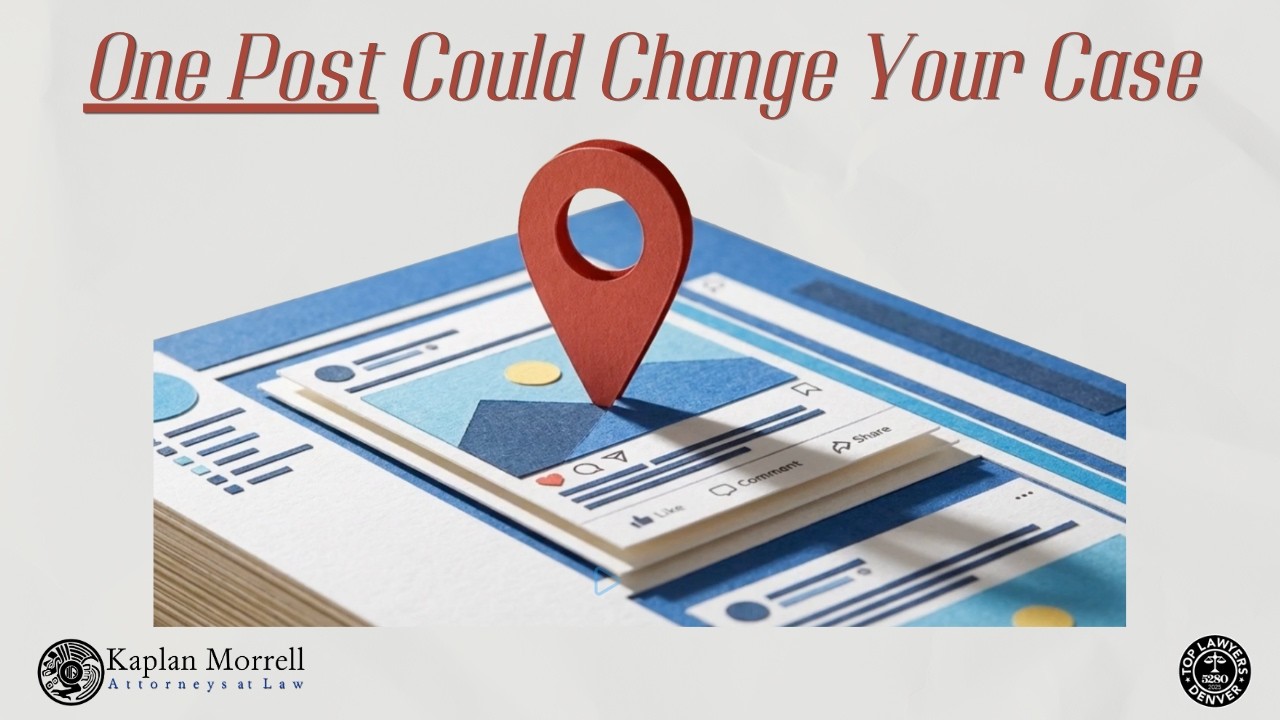
In this video, attorney Britton Morrell reviews 3 cases in which social media played a pivotal role in determining the outcome of a workers’ compensation claim. Follow us on YouTube @KaplanMorrellLaw for more helpful videos related to Workers’ Compensation, Personal Injury, & Immigration.
What happens first? You will be investigated.
When you open a workers’ compensation claim, the insurance company will start their own file to investigate your claim. They will review your social media posts, record you in public, and speak to doctors and adjusters to paint their own picture of your injury. At this point, it is crucial that you change all your social media profiles to Private and ask your friends and family not to tag you or take pictures of you that will be posted on the internet.
Why ask your friends and family to not tag you? Because the investigators for the insurance company will pull pictures and posts from your friends and family and use them as evidence, too.
What are investigators looking for? They are looking for posts that show a clear gap between what you told your doctors and what your life looks like online. We call this the “Credibility Gap”. If you told the doctors you can barely walk, but investigators find pictures of you walking through the grocery store, this can be enough to determine that there is a credibility gap between what you are reporting your injury to be and how it is actually impacting you.
We all know that social media is a place where we only publish the best moments of our lives, not the worst, and in a workers’ compensation case, these positive posts can be used to construe your true story. That is why it is incredibly important to be honest with your doctor and attorney about the good and the bad moments.
Case #1: A client with PTSD, but too many good days (seemingly).
A worker had been assaulted at his job and developed Post-Traumatic Stress Disorder (PTSD) after the assault. He told his doctors that he was a “shut-in”: he didn’t go out, he didn’t talk to anyone, and he didn’t do any of the normal activities he did before the assault. After he opened his case, the investigators at the insurance company looked up his Facebook, and what did they find? A trip to Honduras, him relaxing and smiling on the beach and playing in the water.
Is there anything wrong with taking a trip after you’ve been assaulted? No. People with PTSD have good days and they have bad days, and the good days are not a crime. The problem here lies with what he told his doctors vs. what he was actually doing. If he had told his doctors that he was taking a trip to see family, despite the assault and PTSD, and he followed up by saying the trip helped him feel better, then we have something to work with. But because he told his doctors that he never went out, and then there were suddenly pictures of him out on the beach having fun, the insurance company was able push the narrative that he was being dishonest about his true condition.
The Result? His case was denied and closed because he was not completely honest about his condition.
Case #2: Extreme regional pain + Las Vegas?
Another client was fighting to reopen her case to receive care for Complex Regional Pain Syndrome, a syndrome where you feel extreme pain in your limbs due to an injury. She got this injury at work, and reported that the injury was so severe that she never left the house and never reached out to friends or family.
But her Facebook told a different story. On Facebook, investigators found pictures of trips to Disney World, Las Vegas, Puerto Vallarta, and that she was working for another company as a sales rep. How could she be doing al of this, but continued to tell her doctor that she never left the house?
When confronted with this evidence, the client admitted that she had overstated her isolation so that people would take her injury more seriously. What do we think happened here? We think, at some point, this client decided that she had to describe her pain and injury in absolute terms (ex. “never” or “always”); otherwise, people wouldn’t believe her injury was real. The problem with this way of thinking is that it doesn’t leave room for the good days, or even the days where she had to work despite the pain. When you describe your injury in absolutes, the insurance company will take that literally, so if you say you can’t lift a coffee cup, but they find a picture of you with a coffee cup in your hand, they have evidence to use against you.
When describing your injury and how it has changed your life, give more context and don’t use absolute terms. This looks like:
- “I used to walk a lot, but now I have to take a couple of breaks just to walk to the end of the block.”
- “I used to be able to go to the store and run a lot of errands, but now, after I go to the store, I have to come home and lie down.”
- “I usually go to a family dinner every Sunday, but I wasn’t able to go these past few times because of my injury.”
The Result? Her case was closed, again.
Case #3: A digital trail that saved a worker’s case.
A woman was working for a construction company when the scaffolding she was standing on suddenly collapsed. She fell through four stories of scaffolding, all the way to the bottom, cement filled bricks falling on and around her. When she filed her workers’ compensation case to get care for her life-threatening injuries, she was forced to track down her original employer because none of the companies on the work site would admit who hired her and who she actually worked for.
She was obviously working for someone; why would she have been at the work site otherwise! In her search to prove who her employer was, she found the original job posting on Facebook, and the address at the bottom of the listing was for a company that was on-site the day she was injured. It was thanks to this address that she was able to prove who her real employer was. This time, a single post saved her case. If you are working a job that was first posted to social media, it is a good idea to take lots of screenshots to capture all of the details. You never know, it could be the evidence you need to win your case.
The Result? We were able to pin down her employer and get her benefits and the care she needed.
We could talk about social media and workers’ compensation for hours, but we’ll leave on this high note, and leave a few more examples below. If you are considering opening a workers’ compensation claim, give us a call. Our consultations are Free, and we only get paid if you win.
Connect with Kaplan Morrell
Facebook: Kaplan Morrell
Instagram: @KaplanMorrellLaw
YouTube: @KaplanMorrellLaw
En Kaplan Morrell ofrecemos consultas gratuitas y hablamos español. https://kaplanmorrell.com/es/
Other Social Media and Workers’ Compensation example:
Keep reading below for more examples of how social media impacted other cases.
Example 1: Total Disability and Workers’ Compensation in Court
By claiming permanent total disability when you are injured on the job in Colorado, you are saying that your injury means you are unable to do any job at any employer for any amount of wages anywhere. It’s a very difficult benefit to get awarded in court. In this particular claim, the injured worker said that she couldn’t use her arm. She couldn’t raise her arm or keep her arm away from her body at all. Part of the claim was also that because of the injury, she just stayed home. She couldn’t go out, etcetera.
The parties went to a hearing in front of a judge, and she got on the stand because she had to get on the stand and explain it. When it came time to cross-examine her, the attorney started pulling out pictures and posts from her social media. Those posts showed that she was extremely social and that she was going out to gatherings. She was going out to events and other things. And worse, photos of her using her arm or arms in a way that she said that she couldn’t and upon which she was claiming that she couldn’t work at all: Social Media and Workers’ Compensation.
Attorney Perspective – Reason to be Concerned
Now, the scary thing from a lawyer’s point of view is this: the other attorney, the insurance company attorney, was able to introduce these posts and pictures without giving notice to the client, the injured worker, or her attorney. In other words, the attorney and her client walked into court, not knowing that they were going to be confronted with these posts.
The judge ruled that they were admissible even though they had not been exchanged, even though the other side, the insurance company, had not given notice that they were going to use these posts because, as the insurance company argued, “She’s the one who created them. We’re not surprising her by presenting her with statements and photos that she herself has posted.”
So really, the only person that’s surprised in this room is her attorney, and that’s got to be a big wake-up call because oftentimes we advise clients how to handle social media when they get injured, and we hope, and we pray, that our clients follow our instructions.
Example 2: Settlement Conference with Judge
I’ll go to the case where it was my client this week. We’re in the middle of a settlement conference, and the judge is saying, “You know, if you go to court, they’re going to be pouring through their social media, etcetera.”
Now, the good news is that there was nothing in his email feed or his Facebook feed that violated his restrictions or that was problematic. But what was shocking to me was how much of his Facebook feed was public, meaning you didn’t have to be his friend in order to see it. It was public. If you’re on social media, particularly Facebook, I want you to make sure that what you’re posting isn’t public but that it’s private, seen by only those people that you’ve befriended. If your post has a little globe on it, that means anybody in the world can see that post.
If, on the other hand, it’s got people on it, that means that only your friends can see it, “Facebook friends.” Understand you can also tailor your feed so that only particular friends see your posts and not others. (See Facebook Guidelines here)
Number One Advice to Workers’ Comp Clients
The number one piece of advice that we typically give clients is to not engage in social media while you’re injured. Don’t let people to tag you in photos, don’t let them post pictures with you in them without your permission, and be ready to be honest with your doctor that sometimes you feel well, and sometimes you don’t. Leave room for life’s complexities.
I’ve represented injured workers over the last 20-plus years, and I would say only a handful, less than five, have faked their injury in order to game the system. The vast majority of injured workers are legitimately injured. And one social media post taken in the wrong place, at the wrong time, and without documented explanation can be the difference between receiving benefits or your case being dismissed.
Timestamp of Facebook Posts
I’ve had clients who were treated, and they were doing exercises, and they were just walking a course, not running it, but they tracked it with an app that’s for running. When it automatically posted to social media, it said that she had run three miles when in fact, all she had done was walk three miles.
So things get confused, conflated, exacerbated, exaggerated, and the best course is to just not post at all on social media while you’re injured. It’s also best not to allow people to tag you while you’re on social media. If you are going to be on social media, you need to keep your stuff private, just to your friends.
So, that’s what was happening today in Workers’ Compensation land here in Colorado. I hope all of you have a great weekend, and we will see you again later.
2012 Case: Facebook Posts Almost Cost An Injured Worker 50% of Her Benefits
Questions about Social Media and Workers’ Compensation?
Do you have a Workers’ Comp question you need answered? Contact Kaplan Morrell, the Workers’ Comp experts in Colorado, at (303) 780-7329, live chat with our workers’ compensation team, or via our contact form here. Our team of Workers’ Comp professionals will be happy to answer your questions so you are prepared during the Workers’ Comp process.
Connect with Kaplan Morrell
Facebook: https://www.facebook.com/
Instagram: https://www.instagram.com/kaplanmorrelllaw/
X: https://x.com/kaplan_morrell/
En Kaplan Morrell ofrecemos consultas gratuitas y hablamos español. https://kaplanmorrell.com/es/
READ FULL TRANSCRIPT
Chapter 1: Intro
Hi everybody, my name is Britton Morrell. I’m with Kaplan Morrell, and we’re attorneys who help injured workers in Colorado. Today we’re talking about three social media mistakes that people make when they’ve been injured on the job.
We’re not talking about fraud, intentionally exaggerating problems, or trying to game the system. We’re talking about real, honest, injured workers who simply didn’t know the rules of the world they entered when they got into the workers’ compensation system. It’s a world where everything you do, everything you post, and everything you say is evidence. But even more than that, what other people post about you can also come into evidence and be used against you.
Here’s what most injured workers think when they file a claim: “I got hurt. I reported it. The system is going to take care of me.” They think the world is safe for them, workers’ compensation exists, the adjuster seems nice, and if you get hurt on the job, you’re protected. It feels that simple. You kind of think of it as no different than going to the doctor under your standard medical insurance. But it’s not that simple.
Chapter 2: Worker’s Compensation Basics
The moment you file a claim, the insurance company begins a file on you. That file is worked on by adjusters, attorneys, investigators, and doctors who work for the insurance company—not for you.
One of the very first things they do is hire investigators to conduct a social media search on you. They will look at Facebook, Instagram, TikTok, and whatever is posted publicly either by you or by any of your well-meaning friends. If you have a cute, precocious little teenage niece who has no privacy settings whatsoever and she posts a photo of you, they will find it—whether or not you’re even tagged in it. They will start to look at your family members to see who posts things publicly just to search for information about you.
They’re not scrolling out of curiosity or to be your friend. They’re looking for the gap between what you told the doctors and what your life looks like online.
Chapter 3: What Happens When You File a Claim
Here’s the thing about social media: it’s a highlights reel. We’ve all been there. We’re not posting about our 3:00 a.m. back pain. We’re not posting the fact that we had to go fix the car again, that life isn’t good, or that we’re having to cut back and make adjustments. We’re posting the “best of,” right? Even if it’s brief, even if it’s occasional, we’re only posting the highlights of our life. We post the video of the birthday party or the vacation moments where we’re smiling. We’re not taking pictures of ourselves stuck on a couch because our back hurts.
The insurance company doesn’t see a highlights reel. The insurance company says, “Here are exhibits and evidence we can use against this person.” If your profile is public, it’s fair game. If photos are posted of you on somebody else’s feed that is public, it’s fair game. Fair or not, that’s the reality of the world you’re in when you have a work injury.
Today, I’m going to show you three real cases—three real decisions by administrative law judges here in Colorado—where workers’ compensation benefits hinged entirely on what was posted on social media. Two of them involve cases where social media was used against an injured worker. But the third one changes everything.
Chapter 4: Case #1
In the first case, from March of 2019, a worker had been assaulted at his job. The assault was real, the trauma was real, and he developed post-traumatic stress disorder (PTSD), as you would expect. He described himself to his doctors as a virtual shut-in—someone who had essentially stopped interacting with the world. His doctors believed him and evaluated him based upon what he said.
Then the insurance company searched Facebook and found a trip to Honduras from March 23rd through March 30th of 2018. The photos showed him wading in the water, swimming, dancing, socializing, and smiling.
Stop right there, because I want you to understand this moment. Maybe he was having a genuinely good day. Maybe the act of going out somewhere, being around people, and being outside helped him for at least those few days. People with PTSD, just like people with back injuries, have good days and bad days. Having a good day is not a crime, and having a good day doesn’t mean you’re not injured.
But his doctors didn’t know about those good days because he didn’t tell them. That gap between what he told the doctors and what he was actually doing is where his case died. Once the insurance company showed his psychiatrist these Facebook posts, the doctor revised his report. The new conclusion was that the claimant was actively misrepresenting his mental functioning and intentionally attempting to appear much worse than he was. Consequently, his case was denied by the judge. The psychological claim was ruled not work-related and not covered under workers’ compensation.
Even though the injury and trauma were real, nobody had taught him how to tell his story honestly—including the good days and the trips—without having it weaponized against him. This isn’t fraud. This is not a man who decided to game the system; this is somebody who entered a system he didn’t understand and decided to go without a guide.
Chapter 5: Case #2
Case two is from January of 2021. A woman had suffered a workplace injury and was fighting to reopen her claim. She had a condition called complex regional pain syndrome (CRPS), which causes severe, chronic pain, typically in the extremities. She had told her physician that ever since the accident, she had isolated herself, kept her curtains closed, and lost contact with the outside world.
But her Facebook said something different. During the exact same period that she was reporting extreme isolation, she was traveling. She was going to Las Vegas, Kansas City, Santa Fe, Disney World in Orlando, Puerto Vallarta, and Anaheim. She was also doing outside sales work, selling a product called Zeal for a company called Zurvita. At the hearing, when she was confronted with her Facebook posts, she admitted that she had overstated her isolation.
I want to be careful here because what happened to her is something I see often. She was in pain, the pain was real, and CRPS is a very real condition. But somewhere along the line, she decided the only way to make people take her seriously and believe her was to turn it into an “all-or-nothing” kind of story. She felt she needed to present herself as completely and totally disabled, thinking that if she gave any nuance or admitted to having good days, it would just confuse people. In fact, the exact reverse happened. They will use those good days against you if you aren’t reporting them.
Here is what honest nuance actually sounds like:
“My life is very different now. I don’t get out of the house or travel as much as I used to. For example, I did go to Disneyland with my family, but I didn’t do as many rides as I normally do. I sat more than I stood, and I left the park much earlier. I was stuck in bed for the next two days, but it was at least good for me to get out of the house a little, even if it wasn’t as much as I normally would have done.”
That is the truth of living with a real injury, and that is what believable looks like. What she said instead was, “I don’t go anywhere,” and then a judge watched her walk through Disneyland on Facebook.
One of the most important things we do for our clients—and I say this not as a sales pitch, but as a practical reality—is help them never say the word “always” and never say “never.” Instead, we teach them to say “most of the time,” “rarely,” “usually,” or “but not that day.” The system listens literally, and it is not forgiving of absolutes.
Chapter 6: Case #3
Case three takes place in November of 2023. A woman working in construction fell four stories when a scaffold collapsed while she was filling blocks with gravel. While she was injured, recovering, and fighting for her rights, she had to prove who her employer actually was. There were three different companies involved, none of them were admitting to employing her, and they were all pointing fingers at each other, saying, “Not us, not our responsibility, not our worker.”
She had just fallen four stories; she was clearly working there for someone. Yet, the people responsible for putting her up on that scaffolding were trying to lawyer their way out of it and deny they had even hired her. This is the moment where you truly understand what injured workers are up against. It’s not just about social media; it’s about a system where people with extensive resources and corporate attorneys can sometimes make you and your employment disappear as if you don’t have any evidence.
But she did have evidence. She had found the job through a Facebook posting. The posting listed one company’s name, but it gave a different employer’s personal address for the contact information. She saved that posting. She also showed the court photographs from the company’s own Facebook business page, proving that the second employer was actively on the job site, supervising the projects, and running the operation. Furthermore, she had daily WhatsApp communication between herself and the employer, including phone calls and messages that proved who trained her, directed her, and paid her.
The judge ruled that the second company was her actual employer on the date of the accident, meaning they were liable and responsible. In this case, social media didn’t hurt this woman—it saved her case.
That is the crucial thing I need you to understand. Social media is a knife, and knives can cut in both directions. The insurance company almost always picks it up first, but a skilled attorney knows how to pick it up, too.
Chapter 7: Your Protection Strategy
Here’s the sad truth: by the time people call me, the damage is usually already done. The photo has already been taken and posted. The statement has been signed. The recorded call with the adjuster has already happened—the one where they were told they didn’t need a lawyer. Now things are starting to crash, and I am left trying to build a case around rubble. That’s why I’m sharing this information; it needs to be free and available to you before you need it.
Here is what an attorney does in this world that you cannot easily do for yourself: we know how the system hears you. Literally, when you say, “I can’t lift anything,” what the system hears is, “Here is someone saying they can’t even lift a coffee cup.” All they need to defeat you is a single video of you lifting a coffee cup. When you say, “I never go out,” the system expects your Facebook profile to look like a monastery.
We help you speak the system’s language. That means being precise and honest about your limitations, your good days, and your bad days, so that nothing you say can be weaponized against you. We know what they’re looking for because we’ve watched them look for it in case after case, year after year.
You are walking into a maze that the insurance company, their attorneys, and their doctors walk every single day. You haven’t walked it before, and you need someone with you who knows the paths just as well as the other side does. That’s us.
If you or someone you know is injured on the job in Colorado, get a guide. Get someone to walk with you and help you navigate this maze. We only charge a contingency fee if we are successful, and our consultations are completely free, complimentary, and confidential.
Thank you so much for spending part of your day with me.